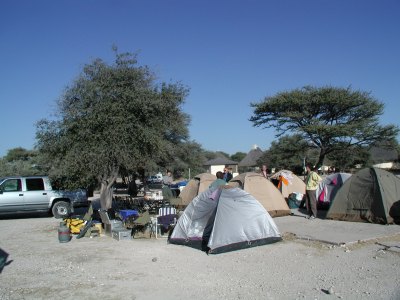
Our camp in Okakuejo after sunrise
What a night! After our late arrival the day before, we had put up our tents in the dark, not really thinking about the consequences of putting them up on a concrete sufrace. We had been observing till almost midnight, which should guarantee a good night's sleep. But on concrete? About three in the morning, surrounded by snoring neighbours and with aching bones I leave the tent and seek shelter in the safari-van. A bit cooler but quiet and soft! About six a.m. preparations for breakfast begin. I skip the photo-safari and get another hour of sleep. Most of the others had similar problems and so we had about the same amount of sleep as on the flight from Frankfurt to Johannesburg.
Our camp in Okakuejo after sunrise
The day begins with a hearty breakfast in the open under a huge nest of weaverbirds, which came in large numbers to eat our crumbs. Just when we started to take down and pack the tents, strong winds turned the job into an acrobatic exercise.
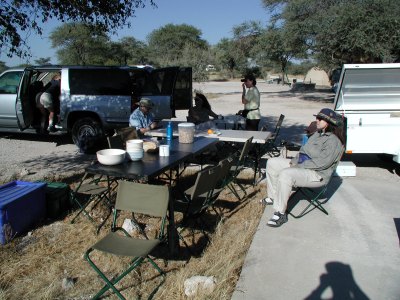
Breakfast - not under palm trees but at least in the open
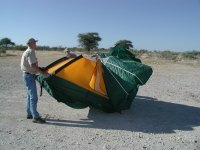
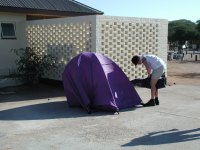
Camera and ... Action! Taking down the tents in strong wind.
After only two hours the whole camp plus equipment was stored in the vans. We decided to make one hour the goal for the end of our trip.
On the programme we had a tour through the fascinating Etosha National Park, which took us close to elephants, lions, zebras, and many other wild animals. Uncountable pictures were taken.
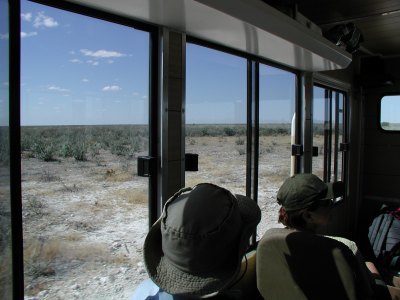
Through the huge plains of Etosha National Park
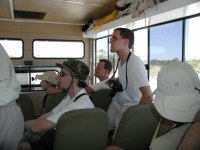
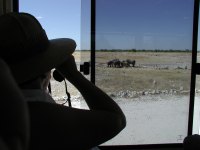
Much better than at the zoo. Of course there are plenty of motives for photographers.
We reached the next camp in Namutoni on time - quite unexpectedly! Before sunset the tents were ready and we saw the sunset not from the car but from the tower of the old fort. But now - showers! The long trip on the dusty roads of the National Park had resulted in a considerable layer of dust on us and our equipment.
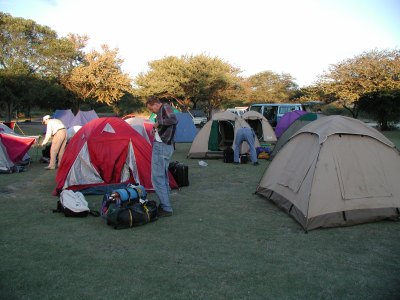
Our second camp in Namutoni
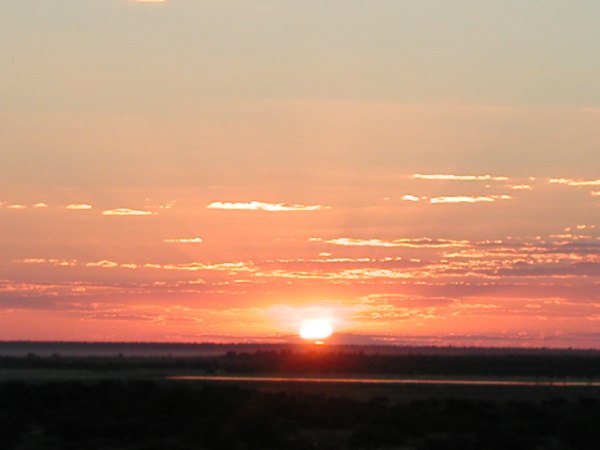
Sunset over Etosha National Park
Dinner again in our field kitchen in the open. Next to it a little star party is starting centred around Wolfgang's 10" LX-200 and Gerhard's 12,5" Portaball. Many smaller telescopes are there too, including Doris' 4", which again proves to be among the best especially for Eta Carinae. Globular clusters are of course a much better sight in the big telescopes. For the complete observation report in German click here..
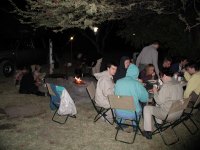
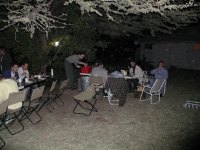
Dinner in the field kitchen. We had an original African
meal, a tasty vegetable stew.
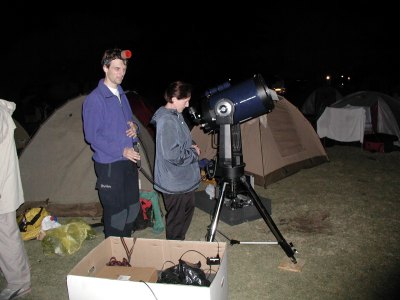
Finally it arrived! Wolfgang is happy about his LX-200
even when the power supply from the van is far too weak.
Doris is impressed by the view of rising Mars.
[ back | Start | Tour | Team | Astronomy | Acknowledgements | next ]